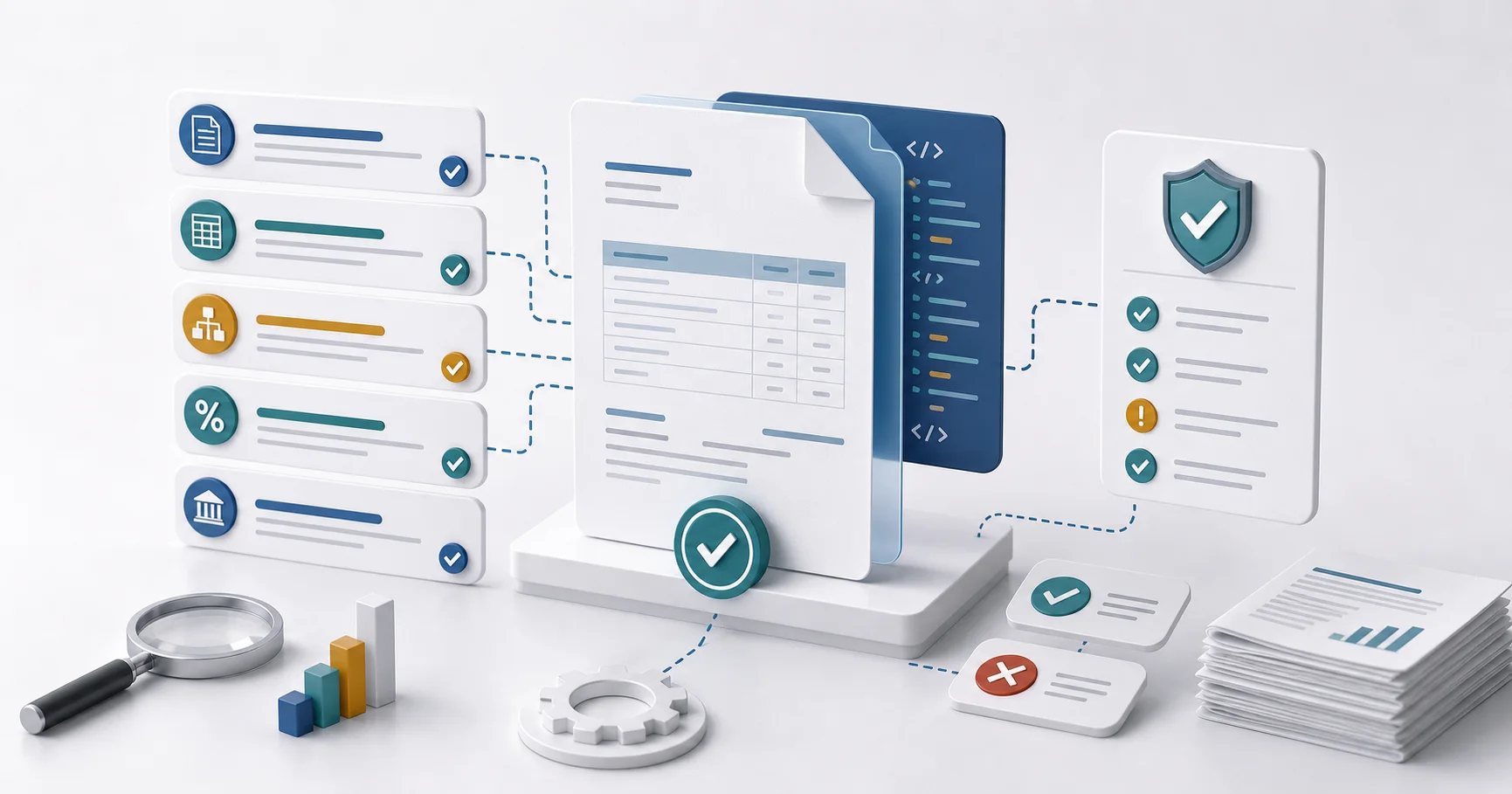
ZUGFeRD validators: what to test before you send a hybrid invoice
Official references
Use these sources to verify dates, formats, and official rule changes.
Related Technical Wiki
Explore deep-dive developer documentation and regulatory guidelines matching this article.
ZUGFeRD and Factur-X hybrid invoices: PDF/A-3 with embedded CII/XML, profile levels (MINIMUM to EXTENDED), validation, and when to choose ZUGFeRD vs pure XML for Germany and EU B2B.
Hybrid PDF/XML review, stale validation, and source PDF readiness.
Understand when a hybrid ZUGFeRD or Factur-X PDF can be accepted as an archive-ready PDF/A-3 file.
This guide is for teams generating ZUGFeRD or Factur-X and wondering whether “the PDF opens” means the invoice is ready to send.
It does not. A usable hybrid invoice needs more than a readable PDF: the embedded XML must match the intended profile, mandatory data must be present, totals must reconcile, and the PDF container itself should meet the archival expectations of the format.
What a validator should actually check
- The embedded XML is present and can be read correctly from the PDF container.
- The invoice data complies with EN 16931 and the selected ZUGFeRD or Factur-X profile.
- Monetary totals, VAT breakdowns, units, and dates are internally consistent.
- The PDF file itself meets the expected PDF/A-3 constraints for a hybrid invoice workflow.
Use more than one kind of validation
A strong workflow usually combines at least two layers. First, validate the business content and XML rules. Second, check the PDF/A-3 container and embedded-file packaging. If a recipient channel applies its own checks, treat that as a third gate rather than your only test.
A practical combination is a ZUGFeRD-aware invoice validator for the XML and business rules, plus a PDF/A validator such as veraPDF for the document container.
Recommended validation workflow
- Generate the ZUGFeRD or Factur-X invoice from source data you have already reviewed.
- Run a rule-based invoice validation against the target profile and EN 16931 expectations.
- Run a PDF/A-3 check on the final document, not on a draft PDF without embedded XML.
- Extract or inspect the embedded XML and compare key fields with the reviewed source invoice.
- Only then send the document through email, portal, or PEPPOL depending on the recipient process.
Common failures and what they usually mean
- The PDF opens normally, but the XML is missing, malformed, or not attached as expected.
- The XML is valid enough to parse, but required business fields or profile identifiers are wrong.
- Line totals, taxable bases, and VAT amounts do not reconcile after extraction or mapping.
- The document looks right to a human reviewer but fails PDF/A-3 checks because the hybrid container is incomplete or non-compliant.
Official and primary references
Ready to convert your invoices?
Convert PDF invoices to XRechnung, ZUGFeRD, and other formats. Subscriptions from €10/month with annual billing (excl. taxes), with a 3-day trial on your first subscription. Or without a subscription: €5 per conversion (excl. taxes).