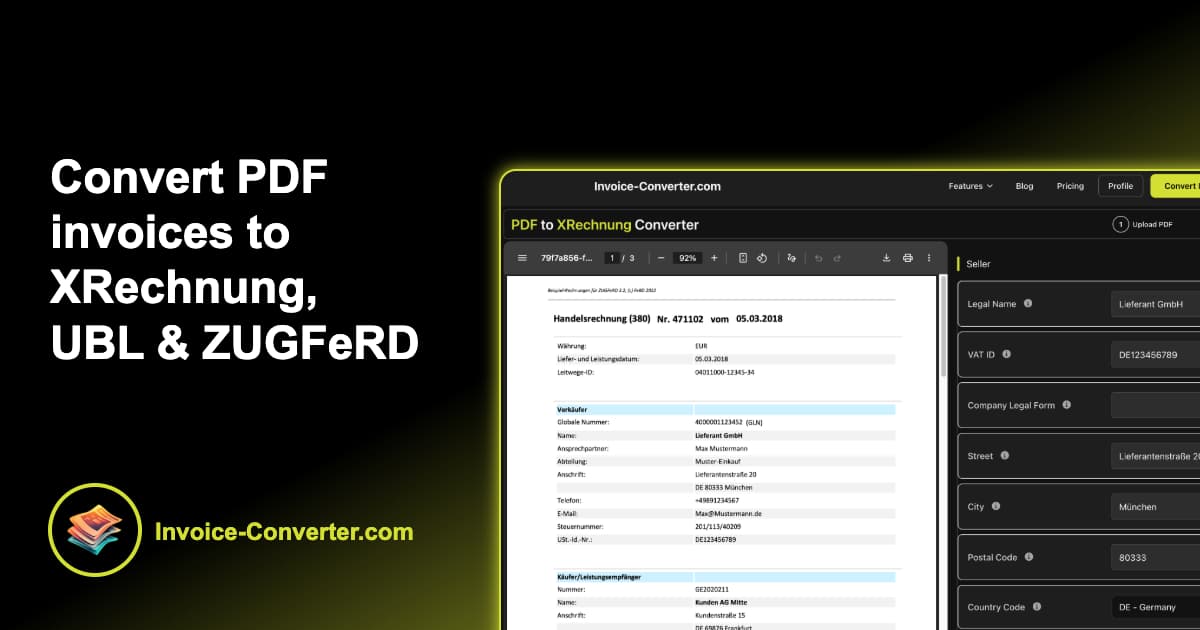
Convert PDF to XRechnung: practical workflow and free trial
Article overview
This article explains Convert PDF to XRechnung: practical workflow and free trial as a practical reference for European e-invoicing. It defines the topic in plain language, places it in the compliance context, and connects the explanation to invoice formats such as XRechnung, ZUGFeRD/Factur-X, UBL, and CII.
Use the article as a starting point before changing a finance or ERP workflow: identify the applicable country rule or standard, decide which structured format is expected, validate the generated XML, and keep a documented exception process for invoices that require manual review.
This guide is for finance teams, suppliers, and ERP owners who still receive or create PDF invoices but now need a compliant XRechnung workflow for Germany.
As of April 20, 2026, Germany already requires all businesses to be able to receive structured e-invoices. The issuing deadlines tighten on January 1, 2027 for businesses above the EUR 800,000 threshold and on January 1, 2028 for the remaining businesses. If your source process is still PDF-first, conversion can be a practical bridge, but only if the output is reviewed and validated.
How to use this guide
Use the article as a starting point before changing a finance or ERP workflow: identify the applicable country rule or standard, decide which structured format is expected, validate the generated XML, and keep a documented exception process for invoices that require manual review.
When PDF-to-XRechnung conversion is the right approach
Use conversion when the upstream ERP or billing system still produces PDFs, while the recipient expects structured XML. It is especially useful during a phased rollout, pilot project, or ERP migration.
Do not treat conversion as a magic replacement for process design. If buyer identifiers, tax logic, payment terms, or line data are missing in the source invoice, those issues still need human review before the XML is sent.
What an acceptable XRechnung output must contain
- A supported XRechnung syntax and rule set, such as XRechnung 3.0.2.
- Mandatory seller, buyer, invoice, tax, and payment fields in the correct structured positions.
- Recipient-specific identifiers such as Buyer Reference or Leitweg-ID where required.
- A validation pass against EN 16931 and the applicable German rule set before submission.
Recommended conversion workflow
- Upload the PDF and check that header data, dates, totals, VAT rates, and line items were extracted correctly.
- Add or correct missing identifiers, especially buyer reference, Leitweg-ID, tax IDs, and payment references.
- Generate the XRechnung XML and run validation before the file leaves your team.
- Review warnings or failed rules, correct the source data, and regenerate instead of patching the XML manually where possible.
- Only then send the invoice through the correct recipient channel, portal, or PEPPOL setup.
Common failure points
- Treating the PDF layout as proof that the structured data is complete.
- Missing buyer reference or Leitweg-ID for German public-sector workflows.
- VAT category mismatches between line-level and document-level totals.
- Assuming the XML is ready to send without a validator report and exception handling process.
Run a trial conversion before changing your ERP
Invoice-Converter.com lets teams upload a PDF, review extracted fields, generate XRechnung XML, and validate the file before go-live. Use it to de-risk a rollout, not to skip review.
Try PDF to XRechnungReady to convert your invoices?
Start converting PDF invoices to XRechnung, ZUGFeRD, and other formats today. 3-day free trial included.
Related articles
EU e-invoicing in 2025: what still matters in 2026
A practical EU e-invoicing guide for April 2026: exact dates for Germany, France, Belgium, and ViDA, plus the rollout decisions teams still need to make.
Read moreHow non-EU suppliers can create compliant invoices for EU customers
A practical guide for suppliers outside the EU: understand EN 16931, recipient-specific formats, routing, and the review steps needed before sending invoices into Europe.
Read moreGermany E-Invoice Mandate 2027/2028: Timeline, €800k Threshold, and Format Rules
Germany B2B e-invoicing timeline explained: receive since 2025, issue from 2027 above €800k, issue for all in 2028. Learn what qualifies as a compliant e-invoice and which formats are allowed.
Read more