Germany E-Invoice Mandate 2027/2028: Timeline, €800k Threshold, and Format Rules
Official references
Use these sources to verify dates, formats, and official rule changes.
Related Technical Wiki
Explore deep-dive developer documentation and regulatory guidelines matching this article.
Learn which e-invoice formats are commonly used in Germany, how routing works, and which identifiers you need for compliant delivery.
What ViDA changes at EU level, what remains national, and how to prepare for cross-border digital reporting from July 2030.
How XRechnung applies EN 16931 in Germany, including XML syntax, validation, buyer references, and delivery channels.
Germany's B2B E-Invoice Mandate: Timeline, Thresholds, and Compliant Formats
Germany is introducing mandatory B2B e-invoicing in stages. Domestic business-to-business transactions are moving to structured formats that meet the European EN 16931 standard, with statutory transition periods. This guide covers the reception requirement from 2025, the €800,000 turnover threshold for 2027, and the broader issuance requirement from 2028.
E-Rechnungspflicht 2027: Wer muss ab Januar E-Rechnungen senden? · Video in German
When you play it, YouTube (youtube-nocookie.com) loads the video, and data is transferred to Google.
Interactive check
Does the German e-invoice mandate apply to you?
Set your 2026 turnover and situation. The grid shows what you must do each year.
Your situation
You must issue e-invoices from 1 Jan 2027. Your 2026 turnover is above €800,000, so the transition ends a year early for you.
Key Deadlines
- January 1, 2025: All German businesses must be able to receive e-invoices (Active)
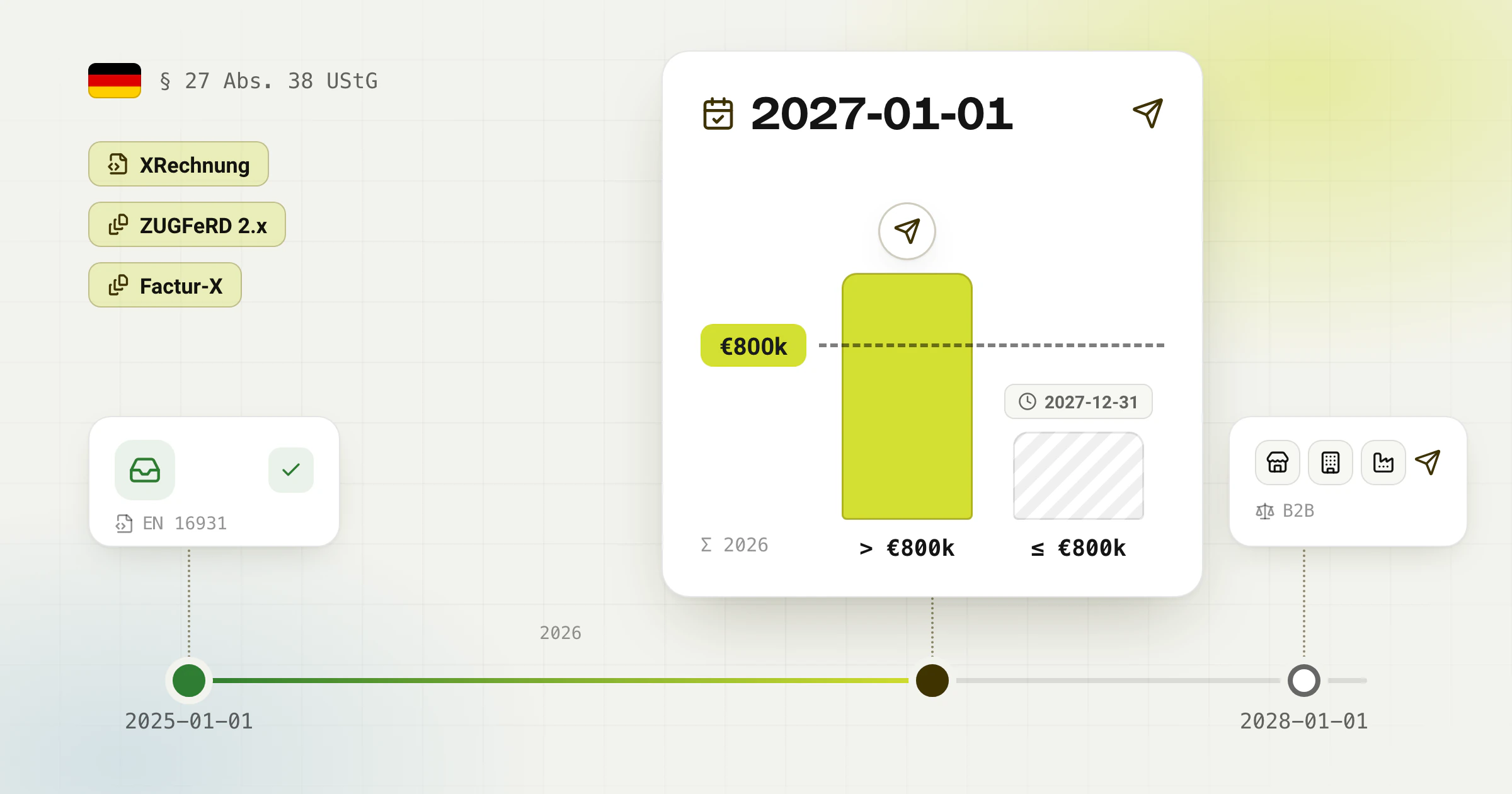
- January 1, 2027: Issuers whose prior-year total turnover exceeds €800,000 must generally issue e-invoices for domestic B2B supplies
- January 1, 2028: The remaining domestic B2B issuers must generally issue e-invoices, subject to statutory exceptions
Status October 2026: These are the dates in the current German VAT Act. The consolidated text of § 27(38) UStG (last amended on 29 June 2026) still allows paper invoices, or other electronic formats with the recipient’s consent, until 31 December 2026 for supplies made in 2025 and 2026. For 2027 supplies, issuers with prior-year turnover of at most €800,000 keep that option, and any issuer may use EDI with the recipient’s consent, until 31 December 2027. Check the Federal Ministry of Finance and the Federal Law Gazette before you rely on a reported change.
The Growth Opportunities Act (Wachstumschancengesetz)
Germany's B2B e-invoicing rules were introduced through the Wachstumschancengesetz (Growth Opportunities Act) and implemented in the German VAT Act. For invoice teams, domestic B2B invoicing is moving from paper or plain PDF toward structured data that meets the statutory e-invoice definition.
Detailed Timeline Breakdown
Phase 1: Reception Capability (January 1, 2025) - Active
Since January 1, 2025, domestic businesses must be able to receive e-invoices. An email inbox is sufficient for receipt, although the invoice itself must meet the statutory requirements. XRechnung and compliant ZUGFeRD/Factur-X are common EN 16931-based examples.
Phase 2: Large Business Issuance Mandate (January 1, 2027)
From January 1, 2027, issuers whose total turnover in 2026 exceeded €800,000 must generally issue e-invoices for domestic B2B transactions. The statutory transition does not extend the option to use paper or plain PDF invoices for these issuers, unless another exception applies.
Phase 3: Universal Issuance Mandate (January 1, 2028)
From January 1, 2028, the remaining transition period expires. E-invoicing becomes the general rule for domestic B2B issuers, subject to statutory exceptions. Kleinunternehmer are exempt from the obligation to issue e-invoices, but they must still be able to receive them.
2027 turnover threshold and preparation
Under § 27 Abs. 38 Nr. 2 in conjunction with § 19 Abs. 2 UStG, the €800,000 threshold is based on the issuer's total turnover (Gesamtumsatz) in the preceding calendar year (2026). In an Organschaft, the turnover of the entire VAT group is relevant.
Prepare before January 1, 2027
- Check the threshold now: Estimate total turnover for 2026 under § 19 Abs. 2 UStG and confirm the final figure when available. If you expect to exceed €800,000, complete setup before January 1, 2027; do not wait for the annual accounts.
- Check receipt and storage: Receiving e-invoices has already been required since 2025. Open a sample XML invoice, check that staff can read it, and retain the original structured data under the applicable recordkeeping rules.
- Agree the outgoing format: Ask key customers which profile, buyer reference and delivery channel they require. Configure your billing software or conversion workflow accordingly.
- Test before the deadline: Review sample invoice data, validate the files and submit through the agreed channel. Check the recipient’s acceptance and assign a person to handle rejected invoices.
Accepted E-Invoice Formats in Germany
| Format | Type | Best For |
|---|---|---|
| XRechnung | Pure XML | B2G, automated processing |
| ZUGFeRD 2.x | Hybrid PDF/XML | B2B, visual PDF + machine-readable XML |
| Factur-X | Hybrid PDF/XML | Cross-border workflows; same hybrid standard family |
Note: Plain PDF emails without embedded XML are not compliant e-invoices. ZUGFeRD MINIMUM and BASIC WL are also excluded because they do not meet the German definition of a structured e-invoice.
Exceptions are separate from the transition periods
The 2028 general rule does not mean "every business without exception". Supplies made by Kleinunternehmer are exempt from the issuing obligation, although Kleinunternehmer must still be able to receive e-invoices. Small-value invoices up to €250 and transport tickets are exempt as well, and invoices for tax-exempt supplies under § 4 Nr. 8 to 29 UStG stay outside the obligation. Read these as standing exceptions, not as extra transition time.
A compliant file is not a delivered invoice
Before you issue, confirm the recipient's format, profile, and channel separately. Conversion prepares the structured file and validation checks its technical rules. Review the invoice facts and tax treatment before sending. Submit the file yourself through the agreed channel; Invoice-Converter does not deliver it through a public portal or Peppol Access Point.
Frequently asked questions
When is e-invoicing mandatory in Germany?
Domestic businesses have needed to be able to receive e-invoices since January 1, 2025. Issuers above the €800,000 prior-year total-turnover threshold generally need to issue e-invoices from January 1, 2027; the general rule applies from January 1, 2028, subject to statutory exceptions.
How is the €800,000 threshold calculated?
The threshold is based on the issuer's total turnover (Gesamtumsatz under § 19 UStG) in calendar year 2026; in an Organschaft, the entire VAT group's turnover is relevant.
Ready to convert your invoices?
Convert PDF invoices to XRechnung, ZUGFeRD, and other formats. Subscriptions from €10/month with annual billing (excl. taxes), with a 3-day trial on your first subscription. Or without a subscription: €5 per conversion (excl. taxes).