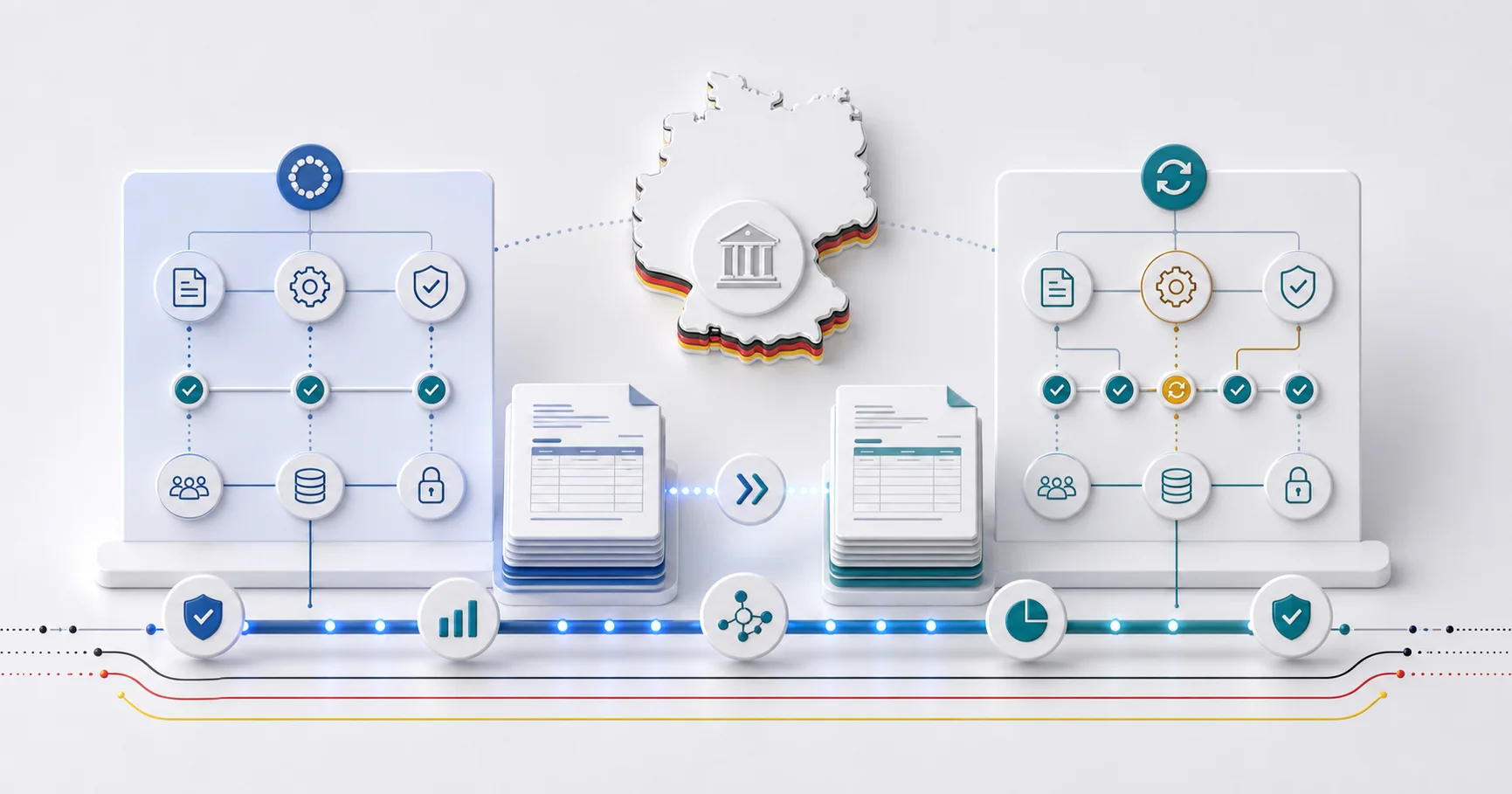
Germany e-invoicing update 2026: what changed and what did not
Official references
Use these sources to verify dates, formats, and official rule changes.
Related Technical Wiki
Explore deep-dive developer documentation and regulatory guidelines matching this article.
Learn which e-invoice formats are commonly used in Germany, how routing works, and which identifiers you need for compliant delivery.
A country-by-country implementation guide for the largest and most mature EU e-invoicing markets: formats, routing, identifiers, pitfalls, and testing.
ZUGFeRD and Factur-X hybrid invoices: PDF/A-3 with embedded CII/XML, profile levels (MINIMUM to EXTENDED), validation, and when to choose ZUGFeRD vs pure XML for Germany and EU B2B.
This page is for teams that know Germany is moving toward mandatory domestic B2B e-invoicing and want a practical update as of April 20, 2026.
The important news is not a surprise delay or a new deadline. Germany is now in the implementation window: businesses have been required to receive structured e-invoices since January 1, 2025, the BMF FAQ was updated on March 23, 2026, and the next major deadline remains January 1, 2027 for issuers whose prior-year turnover exceeded EUR 800,000.
What changed in 2026
- The BMF FAQ was updated in March 2026, which is useful because teams now have a more current official explanation of the domestic B2B obligation and the transition rules.
- The market conversation has shifted from “Is this really happening?” to “Can our ERP, extraction, mapping, and validation process handle live invoice volumes before 2027?”
- More businesses are treating 2026 as the year to deliver structured invoicing capability instead of waiting for the next legal deadline.
What did not change
- Domestic B2B recipients in Germany still need to be able to receive structured e-invoices from January 1, 2025.
- The general transition window for alternative invoice forms still runs through December 31, 2026, with a longer runway through December 31, 2027 for issuers whose prior-year turnover does not exceed EUR 800,000.
- A plain PDF is still not the target structured e-invoice format.
- Human review is still necessary for weak source invoices, missing buyer data, and validation failures.
What this means for finance and ERP teams now
- Identify which German sales flows are in scope and which recipients already expect structured formats.
- Decide whether each flow should land in XRechnung, ZUGFeRD, or another EN 16931-compatible syntax.
- Add validation and exception handling before go-live rather than after the first rejected invoices arrive.
- Train operations teams on buyer references, tax IDs, payment data, and the difference between a readable PDF and structured invoice data.
Where teams still get it wrong
- Treating 2026 as a waiting year instead of an implementation year.
- Assuming a readable PDF is enough because the recipient can visually inspect it.
- Treating validation as a final checkbox instead of part of the invoice workflow.
- Underestimating the workload of rejected invoices and leaving exception ownership unclear.
Official source to monitor
Use the BMF FAQ on mandatory e-invoicing, updated March 23, 2026, as the official reference point. For the wider European context, pair it with your own country-by-country rollout map rather than assuming Germany represents every market.
Ready to convert your invoices?
Convert PDF invoices to XRechnung, ZUGFeRD, and other formats. Subscriptions from €10/month with annual billing (excl. taxes), with a 3-day trial on your first subscription. Or without a subscription: €5 per conversion (excl. taxes).